The Thousand Fortress of Buton Sultanate
Sunday, April 20, 2008
A historical entity of Buton Sultanate is the Keraton Fortification which built since the 16th century under the reign of Sulton Buton III: La Sangaji (Sultan Kaimuddin). On the early years, the fort are made from pile of stones which placed around the capitol to defend the kingdom from aggressors. Further, the Sultan Buton IV: La Elangi (Sultan Dayanu Ikhsanuddin) upgraded the pile stones into a great thick fortress wall.
This world heritage may tagged with the world’s largest fortress since it has 16 bastions, 12 gates, and also 100 cannons! Yes, the largest ever. In details, the fortress is about 2.740 meters square length, 2-3 meters height, with 1,5-2 meters wall thickness. Locals give another name upon the site as “The Thousand Fort”, because it has many smaller fortresses inside the main fortress.
There were several folklores in accordance with the fort upgrade. Some says that the stones were elaborated each other with tons of eggs. The protein part of the egg. An elder among locals, La Ode Abu Bakar, said that the egg was not the only element whics is used to built up the wall. “It’s almost impossible to gather and stick all those gigantic number of stones. Therefore, they used also calcium and some part of jelly so then they had a thick mixture of adhesive". Hard enough to made a hundred years fortress.


Mosque and the Cemetery
As we step into the fortress, the surroundings would turn backwards in early years when the gold, gospel, and glory were the magical words for European sailors. Wood houses with floor stated 2 meters above the ground, which is called ‘rumah panggung’, spreads around. The dwellers are still considered as the big family of the Sultanate.
The Great Mosque Keraton is the center of the locals activity, also another main attraction instead the fortress. It was build under the order of Sultan Sakiyuddin Darul Alam (Sultan Buton XIX) with 20,6m x 19,4m in large. Philosophically, there are symbolized numbers around this mosque which is associated with some meanings. 313 pieces of wood that made up the mosque were associated as the number of bones of human beings. 17 step ladders of the mosque associated with the number of rakaat in shalat (moslem’s pray) in a day. Also the number 99 of Allah’s name resembled in the length of ‘bedug’ (moslem’s drum).

Not far from the mosque, lies the cemetery of the last king of Buton: Murhum. He was also known as Sultan Kaimuddin. Buton became an Islamic monarchy under his reign since he decided to accept Islam as the religion. The kingdom became Sultanate then.
When you feel wander enough around the site, you may take a lean rest on a beach named Nirvana, located near the fortress. The view? Undoubtedly astonishing!
... read more
posted by Daniy @ 10:24 PM,
,

Underwater Kingdom of Bunaken
Friday, November 09, 2007
On the north of Sulawesi, lies a beautiful and astonishing Indonesian tourism spot: Bunaken. Formerly established in 1991, it is among the first of Indonesia’s growing marine parks. For scuba divers, it is an undeniable spot to get involved with. Generally, Bunaken is an island which large 8.08 square kilometers in Manado Bay. Around the Bunaken island, an area of 75,265 hectares large, is the Bunaken National Marine Park which consists five islands: Manado Tua, Bunaken, Siladen, Mantehage, and Naen. Instead of the large occupied area of the park, the diving spots are only found around the coasts which surrounds each island.

Fish, Corals, Clams: It’s All Here!
Talk about its biodiversities, you can count to Bunaken’s collection of corals, fish, echinoderms or sponges - and the number of families. Then you can conclude that genera or species around is bound to be remarkably high. Don’t you know that 7 of the 8 species of giant clams that occur in the world, occur in Bunaken? Also, it has around 70 genera of corals, which you can compare this to a mere 10 in Hawaii. Acc
 ording to the statistics, nearly 70% (about 2,500 species) of all fish species which are known to the Indo-western Pacific, are found around Bunaken. It’s slightly higher than in the Philippines.
Well, if you wonder why Bunaken National Marine Park is such a treasure trove of biodiversity, the Oceanic currents may explain. Northeasternly currents generally sweep through the park but abundant counter currents and gyros related to lunar cycles are believed to be a trap for free swimming larvae. This is particularly true on the south side of the crescent-shaped Bunaken Island, lying in the heart of the park. A snorkler or diver in the vicinity of Lekuan or Fukui may spot over 33 species of butterfly fish and numerous types of groupers, damsels, wrasses and gobies. The gobies, smallish fish with bulging eyes and modified fins that allow them to attach to hard surfaces, are the most diverse but least known group of fish in the park.
The abundance of hard corals is crucial in maintaining the high levels of diversity in the park. Hard corals are the architects of the reefs, without them, numerous marine organisms would be homeless and hungry. Many species of fish are closely associated with particular types of corals (folious, branching, massives, etc.) for shelter and egg-laying. Others, like the enormous Bumphead Parrotfish, Balbometopon muricatum, are "coralivores" and depend on hard corals for their sustenance. Bony mouth parts fused into an impressive "beak" allow these gregarious fish to crunch corals like roasted peanuts.

Dive.. Dive.. Dive..!!
Back to the business. It is not hard to find and get yourself underwater. A lot of dive centers is operating from the mainland around Manado and directly from Bunaken Island. Talk about satisfying underwater adventure, a more few dollars are better expensed for safe and experienced operators than just choose the cheapest one. Tank fillings can be a problem. Some operators may saves money on filters which may gives you headaches after each dive.
20 diving spots vary in depth, from 2 meters down to 1,344 meters deep. 12 of them are found around Bunaken island, lies from southeast to northwest of the island. On this area, you can find the underwater great walls (which also called hanging walls) which stands vertically and bended upwards. The walls have been the source of food of surrounding fishes around Bunaken Island.

How Do I Get There?
The public boats from Manado to Bunaken are leaving daily around 2 p.m (depending on tide), except Sundays, from Pasar Jengki near Manado harbour. Back from Bunaken to Manado usually early in the morning, around 7-8 a.m. Even on Sundays there might be boats, just go to the harbour and ask people there. To charter a boat is about Rp. 150,000 - 200,000 OW. If you want to go to Siladen it is better to inquire first at the harbour, but usually there are several boats as well. The fare to Siladen is also Rp. 15 000.
A number of homestays are available on the island which rates around Rp 50,000.00 per day per person. But you may displeased by some things like the water in the bathroom is left unfilled or dissatisfying breakfast. If you want a better service, some dive operatorions offer more upmarket accomodation which will please you with running water (Living Colours) and hot showers (Cha Cha Nature Resort).
You can look for another reference on the link below:
Sulawesi Info , Sulawesi North Diving
... read more
posted by Daniy @ 5:28 AM,
,
Tana Toraja, Between The Cliff and The Dead
Thursday, September 20, 2007
Between the mountainous terrain of southern Sulawesi, you’ll be welcomed by religious spectacle and the hospitality of the Torajan’s [not Trojans! ^_^] people. With majestic panoramas, captivating villages and dramatic ceremonies, Tana Toraja is the undisputed highlight of any journey to Sulawesi.

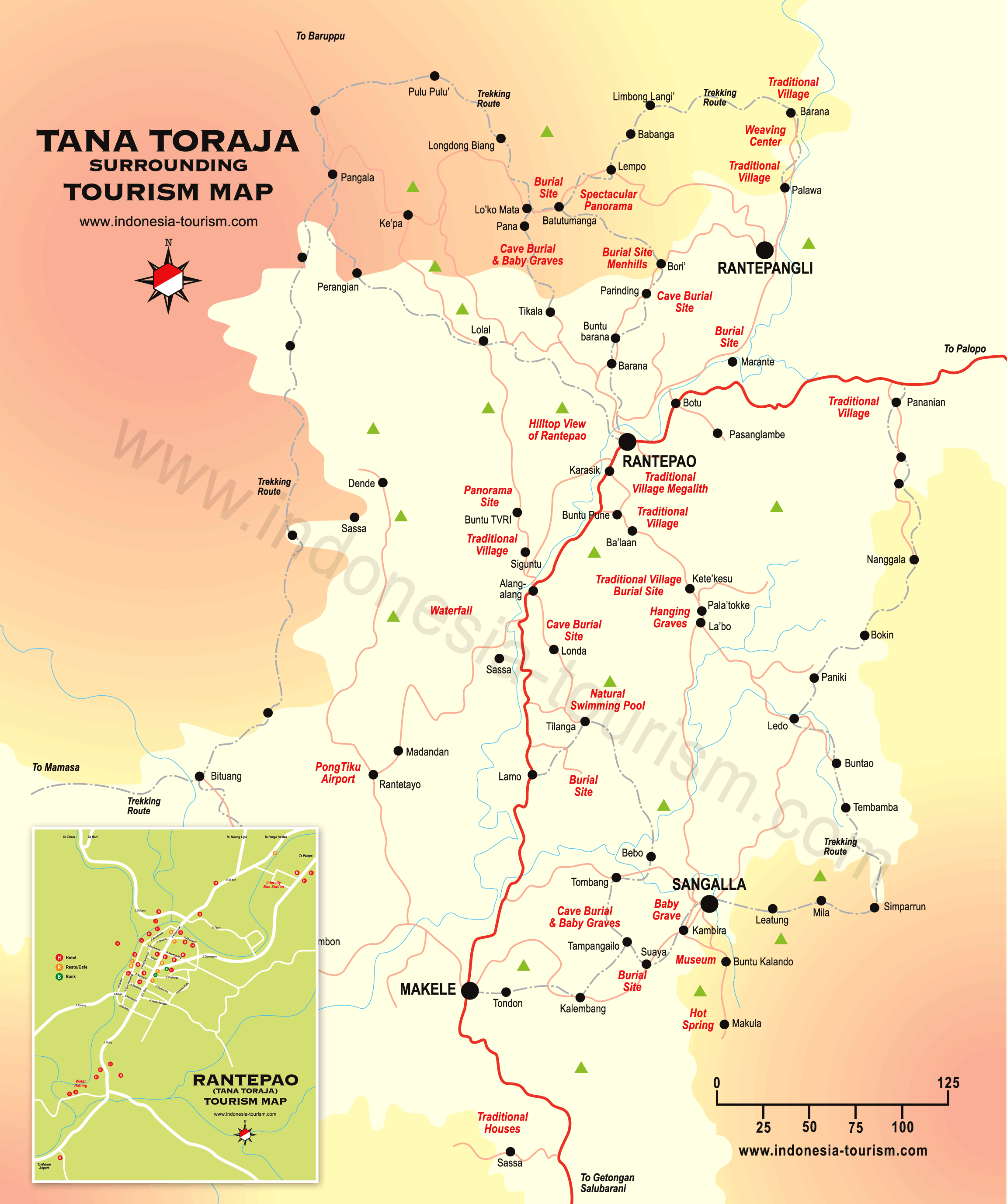
click here for better resolution of the map
As the development of the tourism activity on this region, you’ll get no difficulties to find several star-rated hotels, tourism center, internet service, and other upgraded infrastructures which opened Tana Toraja highland to visitors of all interests. About 60 cheap lodgings are also available for backpackers, so you don’t have to worry about where to spend the bedtime. The main attraction of Tana Toraja is their beliefs and the way of life, which you can experience easily around the sites in the town of Rantepao (district capital), 328 kilometres north of Makassar. A gate built in traditional boat-shaped architecture, marked the spot as the entry of Tana Toraja (Toraja Land). Various of handicrafts and unique shops can be easily found in the traditional village called Kete. It’s another unique memorabilia beside the photographs you could take around your journey in Tana Toraja.
The Torajans believe that their forefathers descended from heaven onto a mountain some twenty generations ago. A traditional cult called “Aluk Todolo” governs all traditional ceremonies which is still follows by the majority people of Tana Toraja. Their colorful culture is especially rich in elaborate sacrificial, post mortuary, and cave burial sites. Between the magnificent cliff graves, Lemo and Londa are the easiest sites to reach. These graves are filled with the effigies of the dead called Tau Tau which depict their nobility. You can hire young village guides to guide you up to the graves so you can see skeletons and old coffins.


But not only the graves will amaze your curiosity. The festival before the dead is buried along the cliff is also an event that shall not be missed. People will hold a party called Rambu Solo in order to respect the spirit of the deceased. Rambu Solo is divided into four levels which is described upon the social status of the dead. The higher the status, the longer the party will took. The corpse is placed inside “Tongkonan”, the traditional house of Tana Toraja, while people performs bull fight, music plays, dances, and bull slaughter. According to the belief, the more bulls and pigs are sacrified, the better status of the deceased will have in the afterlife.
posted by Daniy @ 6:20 PM,
,